
Breaking the Cycle: Parenting While Living with Complex PTSD By Rachel Zirkin Duda
/
Over time, I internalized the idea that there was something fundamentally wrong with me. I couldn't understand why I seemed to attract so much cruelty, but I became convinced I must deserve it. This belief followed me well into adulthood. I still feel the sting to this day.
When I was a little girl, I learned how important it was for me to pay attention to how hard my father closed the door when he came home from work. If he slammed it shut, I knew I needed to hide.
I would pile up pillows and blankets in my closet, put my small black-and-white TV set in there, dive in, and close the bi-fold doors (as well as I could with all the bulky bedding). I thought of the closet as my own little apartment. It was my escape. Most of the time, nobody noticed I was missing, so I would stay hidden until the coast was clear.
Unfortunately, there were times I was caught unaware and accidentally stepped on a landmine. Out of nowhere, I would hear the telltale sound of my father’s shoes pounding angrily up the stairs, and I would freeze in fear. He would blast through the door, nostrils flaring, and spank me until I was shaking and sobbing. Sometimes I didn’t even know what I had done wrong.
I wasn’t aware of it at the time, but those experiences were laying the groundwork for a lifetime of complex post-traumatic stress disorder (CPTSD).
When the People Who Should Be Protecting You Cause You Harm
CPTSD develops due to recurrent traumas, the effects of which are often reinforced by repeated emotional microaggressions over a long period of time. Throughout my childhood, I got the same messages: I didn’t matter, my feelings didn’t count, and everything that happened to me was my own fault.
My father's unpredictable rage left me hypervigilant. My maternal grandfather was controlling, emotionally cruel, and sexually abusive. My paternal grandmother was a mean drunk. Both could have been classified as malignant narcissists.
Outside my family, things weren't any better. Beginning when I was five, I endured seven years of intimidation, coercion, and abuse from an older neighborhood boy. At school, I was bullied, humiliated, and sexually harassed by classmates – and when I finally sought help from adults, I was told that my sensitivity was the reason I was always being targeted.
One school guidance counselor suggested that if I didn't cry so much, the other kids might leave me alone. Another told me I was causing my own problems because of a “self-fulfilling prophecy.” She explained that kids bullied me because I believed they would.
Think about that for a moment. I was being bullied because I expected it to happen? It had nothing to do with the kids who harassed me? No. Apparently, it was all me.
I was being mistreated, and the adults who were supposed to protect me were telling me that I was responsible for the mistreatment – and I believed them. How could I not? I wasn’t getting any competing messages.
Over time, I internalized the idea that there was something fundamentally wrong with me. I couldn't understand why I seemed to attract so much cruelty, but I became convinced I must deserve it. This belief followed me well into adulthood. I still feel the sting to this day.
The Trauma Doesn't End When the Abuse Stops
Even years after the childhood abuse ended, I often had unexpectedly strong visceral responses to situations that other people considered relatively minor. These out-of-sync reactions filled me with shame because I didn’t know why they were happening. I now have a better understanding of what was going on.
When you have CPTSD, your nervous system may register alarm when nothing is obviously wrong. This happens because, to your subconscious mind, you are in present danger, but in reality, you are reacting to a threat from the past. I have since learned that this is called an “emotional flashback.” My brain never explained that to me, of course. I just felt a rush of fear, anxiety, and humiliation that left me reeling.
I had spent so much of my childhood being told I was too sensitive, too emotional, or somehow responsible for other people's behavior, that I began repeating those accusations to myself.
Eventually, I no longer needed someone else to shame me. The messages had become part of my internal dialogue. I carried those experiences into my relationships, my work, and my sense of identity – but the one thing I did NOT want to do was carry on the tradition of intergenerational trauma in my family.
Becoming the Parent I Needed
I was 34 when my son, Seth, was born. Long before becoming a parent, I had promised myself that if I ever had kids, I would do everything I could to spare them the kinds of experiences that had warped my youth. I wanted to raise a child to become a healthy, relatively happy, well-adjusted adult – whatever that meant to him/her/them.
I had all the best intentions, but I never expected a child like Seth. From a young age, Seth struggled with intense emotional reactions, and sometimes his anger became physical. His behavior could be frightening, especially since I had spent so much of my own childhood being victimized by aggressive people.
There were times his behavior triggered flashbacks. I was simultaneously trying to help him manage overwhelming emotions while struggling with my own. I was afraid he was turning into a bully. Sometimes I had to remove myself from a situation because I was freaking out internally, and I needed to get myself together. I often doubted my capacity to handle what was happening.
But I was determined to raise Seth differently than I was raised. I wanted him to understand that his feelings were acceptable, even when certain behaviors were not. I also wanted to establish boundaries without shaming him or inciting fear. That was not always easy, especially when my own nervous system responded to situations as though I were still the frightened little girl hiding in her closet, but I did my best.
It is important to note that Seth’s aggression came from a different place. He wasn’t a bully. Seth was diagnosed with autism at sixteen. A few years later, we realized he has a PDA profile. PDA stands for “Pathological Demand Avoidance” or “Persistent Drive for Autonomy.” A PDAer’s behavior may appear oppositional, but despite the label, they aren’t simply avoiding demands. When someone with PDA is faced with even a basic request, their nervous system becomes dysregulated, leading to fight, flight, freeze, shutdown, or other attempts to escape or regain control.
A few years later, I learned that I have the same diagnoses, which adds an additional degree of complexity to my already overwhelming CPTSD. These unknown circumstances complicated things with Seth at times, but we both now have a much greater understanding of the dynamics of our relationship – and we learn more every day.
The Moment I Became the Protector
One afternoon, when Seth was about six, we were visiting my parents. Seth was playing with one of their recliners, releasing the footrest and then pushing it back in – over and over again. When I noticed my dad’s nostrils start to flare, I knew there was going to be trouble. He suddenly lunged toward Seth, about to grab his wrists the same way he used to grab mine when I was little – and for a moment, the past and present collided.
But this time, I did something different. Instead of freezing, I stepped between them. I barked at my father, "Go upstairs right now, Dad! I will handle this!" He was startled by my intensity but did what I asked. I took Seth home.
Seth was confused. I knew he was too young to understand the intricacies of the situation, so I simply said, “Grandpa was afraid you were going to break the chair.” I explained that while his grandfather should have handled his anger differently, chairs are for sitting, not playing, and in the future, he needed to be more respectful of other people’s belongings.
Later, I told my father that threatening Seth was unacceptable, and if he ever did it again, he would lose us both – permanently. My father promised that if he became that angry again, he would walk away. Fortunately, he kept his word.
Looking back, I recognize how significant that moment was for me. As a child, I had desperately needed someone to intervene when an adult lost control. Decades later, I was able to be that person for my son. I may not have had protection growing up, but I was going to make darned sure Seth did.
The Complicated Work of Healing
One of the hardest parts of CPTSD is recognizing how deeply our early experiences can shape how we interpret ourselves and the world. For much of my life, I believed that if someone hurt me, I must have done something to deserve it. I had been taught that my emotions were too much, my reactions were inappropriate, and my suffering was somehow my responsibility. Those beliefs became so deeply embedded that even recognizing them didn't make them disappear.
Parenthood brought some of those wounds into sharper focus. I could recognize when Seth was being treated unfairly. I could defend his right to have feelings, make mistakes, and be respected – and yet, extending that same compassion to myself is extraordinarily difficult.
My family relationships have changed over time. My father has acknowledged the harm he caused, and my mother has apologized for the times she couldn't protect my sister and me. I appreciate their willingness to take responsibility and work toward repairing our relationships, but unfortunately, forgiveness, understanding, and healing are not interchangeable, and none of them automatically make the physical and emotional effects of CPTSD disappear.
Mending Together, Building Together
Seth and I co-wrote a memoir, Mending Together, Building Together, which explores our relationship and the experiences which shaped it. Writing the book required me to revisit parts of my childhood I spent decades trying to understand. Some discoveries were intensely painful. Others helped me recognize connections between my childhood experiences and the parenting choices I made many years later.
I began to see that my determination to protect Seth wasn't simply an abstract parenting philosophy. It was rooted in knowing what it felt like to need protection and not receive it. (But at the same time, I encouraged him to fight his own battles once he was ready to do so. In my opinion, being overprotective can be just as harmful as not being protective enough.)
I grew up being blamed for other people's cruelty. I knew the fear of expressing emotions around unpredictable adults. I understood how damaging it could be when a child's feelings were treated as inconveniences rather than legitimate experiences – and I wanted something different for my son.
I wasn’t perfect. I struggled with emotional flashbacks, shame, and self-doubt. And I continued to live with the effects of decades of complex trauma. But I also learned that breaking an intergenerational cycle doesn't require perfection. It requires a willingness to examine our patterns, acknowledge our mistakes, respect our children's individuality, and repair relationships when things go wrong.
Most importantly, it means recognizing that our children are not responsible for our wounds. Seth didn't cause my childhood trauma, and he was never responsible for healing it. But raising him challenged me to face experiences and beliefs I might otherwise have continued avoiding. As I became the parent I wanted to be, I started to understand more about the child I once was. And perhaps that is one of the most meaningful parts of my experience: I was able to give my son some of the compassion and understanding I desperately needed myself.
I'm still learning how to extend that same compassion to Rachel.
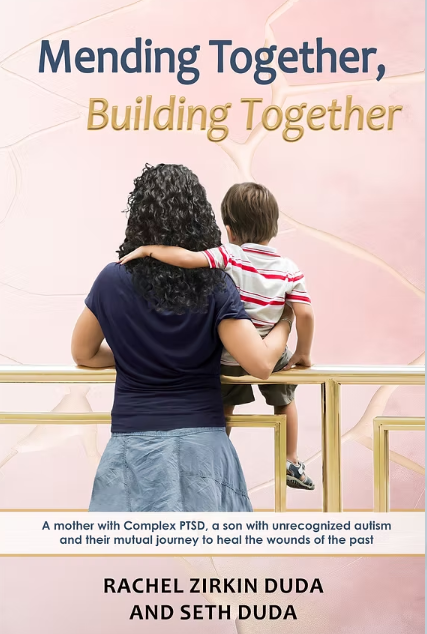
About the Author: Rachel Zirkin Duda is an award-winning author, photographer, and graphic designer. She and her son co-wrote Mending Together, Building Together, a memoir exploring childhood trauma, complex PTSD, parenting, and intergenerational healing. They are now working on Bridging the Gap: A Mother and Son Learning Each Other’s Language, the first book in a series that will explore multiple aspects of communication.
