
The Perfect Crime: Why I Couldn't Say What Happened to Me by Asaf Anonimi
/
Recovery was not a straight line. I fell, and I got up. And I fell again. Slowly, between the falls, I built something I didn’t know I had: resilience.
For most of my life, I believed something was wrong with me.
Not with what had happened to me. With me. I was the one who couldn’t explain. The one who froze when someone asked a simple question. The one who knew he was hurting but couldn’t point to why.
It took me more than forty years to understand that this was not my failure. It was the design.
The day the words wouldn’t come
I remember the morning I finally tried to tell my brother.
“I don’t feel well,” I said. “I don’t know what to do.”
“What do you feel? What’s not right?”
I opened my mouth, and nothing came out. I wanted to tell him why I hurt, why I was pressured, why everything was so hard. And suddenly I couldn’t put what had happened into words. It was as if none of it had really happened, as if it were all a reality I had built in my head.
And then I understood. The perfect crime had been committed.
Not a word had been said. Not an act had been done that anyone could name. Everything was by hint: looks, songs that seeped slowly into my ears, words that slipped in between the sentences. A crime laundered so completely, it had never existed.
I had nothing to say, because there was nothing to point to.
What a child learns from silience
If you grew up the way I did, you may know this feeling. The harm doesn’t always arrive as a blow. Sometimes it arrives as a look across a room, a joke everyone laughs at except you, a message that is never spoken but is always understood.
A child can’t bring a look to a teacher. A child can’t show a parent a tone of voice. So the child learns the only lesson available: stay quiet. Stay small. Stay.
I learned it so well that I carried it through my adolescence, through years of anxiety, through not fitting in anywhere, through relationships and jobs where I always felt one step outside the room.
When I finally asked for help
My brother gave me simple instructions. “You go to the doctor. He asks why you came. You say, I need help. He asks what help, you don’t have to explain. You just say, I need help.”
So I sat in front of the doctor and said it.
“Explain to me what help you need.”
I tried. I sounded clumsy, broken, unclear.
“And you think I have time to sit and listen to these things now?”
I waited half a year for the next appointment. Half a year, I lay at home, fading.
I’m sharing this not to blame one doctor, but because I know many of you have heard a version of that sentence. From a professional, a family member, a friend. It is the second wound, the one that tells you the first one wasn’t real enough to matter.
It was real. And so is yours.
The language no-one taught me
Years later, I began to understand something that changed everything. All my life there had been a whole language between people: in looks, in tones, in hints, in silences. Everyone around me seemed to speak it. I never did.
The same language that was used to hurt me was the one I had never been taught to read. That is why I couldn’t explain. Not because nothing happened, but because it happened in a language that leaves no evidence.
When I understood that, the shame began to loosen. I wasn’t the broken one. I was a child who had been left outside a door that no one told him existed.
Falling, and getting up
Recovery was not a straight line. I fell, and I got up. And I fell again. Slowly, between the falls, I built something I didn’t know I had: resilience.
I married the love of my life. Together we raised three children who grew up kind and giving to others, in the shadow of everything I carried. For many years I worked with children and teenagers in distress. I recognised them immediately: the ones who explode, the ones who disappear, the ones who can’t say what happened. I didn’t push them to explain. I sat beside them. First week, silence. Second week, a glance. And one day, they sat beside me without being asked.
That is what I never had: someone who sees, without demanding proof.
If you can’t find the words yet
If you are still in the silence, I want you to know three things.
You are not imagining it. The absence of evidence is not the absence of harm.
You don’t need to explain it perfectly to deserve help. I need help is a complete sentence.
And the flood can pass. Not because the pain disappears, but because one day you learn to see even when the pain is there.
I wrote my memoir, Asking for My Right: The Voice of a Child, for the child I was, who had no words. If you are that child too, I hope you find some of yours in it.
— Asaf Anonimi
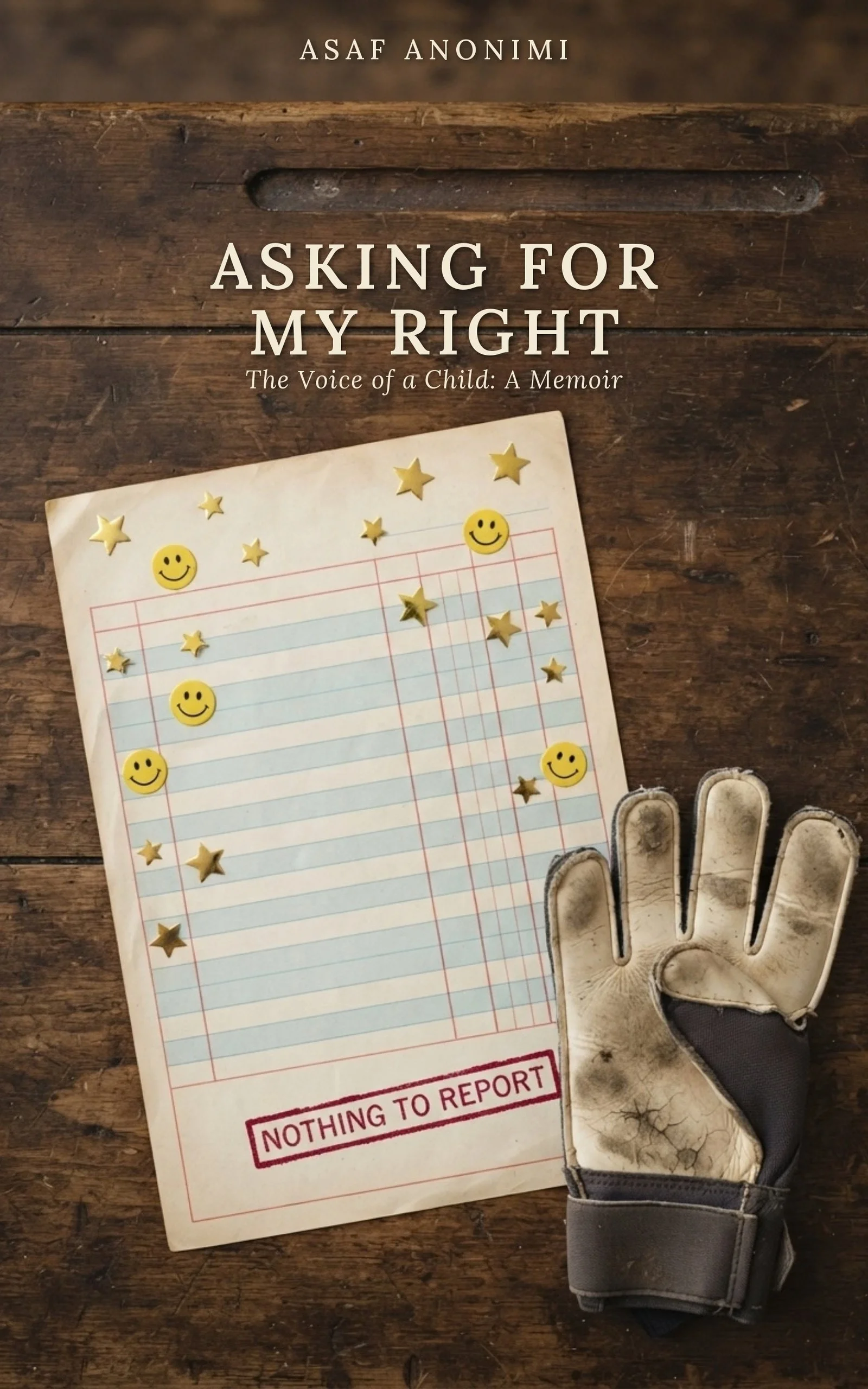
Asaf Anonimi is a former high school teacher and retired educator who spent years working with children in state care and special education. He writes under a pen name to protect himself and his family. His memoir, Asking for My Right: The Voice of a Child, was written for the child he was.
